

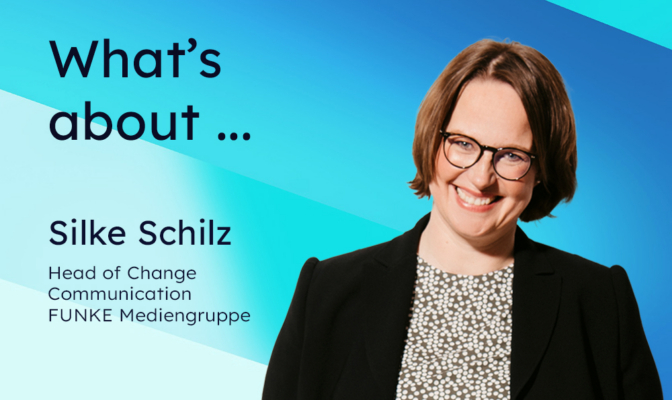
We have been an established player in the German strategic communications market for 30 years now. Over the course of our company’s history, a number of our colleagues have moved on to other companies, associations, institutions, start-ups or other consultancies. We have maintained collegial, friendly contact with many of them since. From now on, every six weeks we will ask one former colleague: What are you up to right now?
Which skills and experiences from your time in strategic communications consulting have proved particularly valuable in your current in-house role?
One of the most important skills I gained during my time in strategic communications consulting is the ability to observe with precision. I learned to look and listen very closely: where do messages and lived reality not align, and which questions and uncertainties remain unspoken? This helps me today to identify shifts in sentiment at an early stage and to address communication needs in a targeted way.
Equally important is the focus on linguistic precision. In a media company, where everyone works professionally with language, any lack of clarity is immediately apparent. Clarity, nuance and care in wording are therefore central elements of internal change communications.
In addition, my experience across different industries and transformation processes is invaluable. It enables me to better understand typical dynamics, resistance and questions during periods of change, and to plan measures realistically.
Combined with a careful and considered approach, this forms the foundation of my work at FUNKE today – particularly at a time when both our company and the industry as a whole are undergoing profound transformation.
The changes in the media industry range from AI and new usage habits to evolving business models. Where do you currently see the greatest communication challenges in balancing the journalistic mission with economic transformation?
From my perspective, the greatest challenge lies in communicating economic imperatives transparently without undermining the journalistic mission. FUNKE’s guiding principle is: for an open and informed society. This is what we strive for every day, both in our editorial teams and in our publishing units. Our employees want to understand how the changes in their workplaces contribute to safeguarding the journalistic mission in the long term.
The profession of traditional journalism is currently undergoing a fundamental shift. New usage habits, digital platforms and AI-supported processes are reshaping roles, ways of working and expectations. Alongside these developments, we must consistently safeguard our journalistic quality, even as formats, workflows and distribution channels change significantly. This raises fundamental questions for many journalists: what does “good journalism” mean in a world of push notifications, social media logics and data-driven decisions?
This is precisely where communication can act as a bridge. It creates spaces where our journalists can learn from one another, share experiences and jointly develop new professional standards. In doing so, a shared understanding emerges of how to work on new channels without compromising editorial principles.
Communication can play a crucial role in helping us understand and internalise that these changes are not in conflict with our journalistic mission. On the contrary, they are a prerequisite for fulfilling it in the future – in different roles, across new channels, but with the same commitment to quality and responsibility.
Journalists are professionally trained to question narratives, arguments and underlying interests. What are the implications of this for the design of change communications in media organisations?
In my view, it is essential not to see critical questioning as an obstacle, but as something entirely natural. Journalists are used to scrutinising statements, testing arguments and considering different perspectives. They apply the same approach to their own organisation.
That is why change communications in a media company works best through transparency: explaining the background, outlining different perspectives and making clear how we intend to shape the transformation together. It is equally important not to conceal the fact that the path may be challenging. This creates far more credibility than presenting change as easier than it really is.
Trust develops when employees feel that their questions are taken seriously and that genuine dialogue is encouraged. Critical discussions take time, but they usually lead to better decisions and greater acceptance. It also makes a significant difference when top management embraces this mindset and is open and approachable – something I am fortunate to experience at FUNKE.
Ultimately, communicating with journalists differs less from other audiences than one might assume. The expectations in terms of transparency, clarity and credibility are simply higher. Meeting these expectations already represents a significant achievement.
More about Silke Schilz on LinkedIn.