

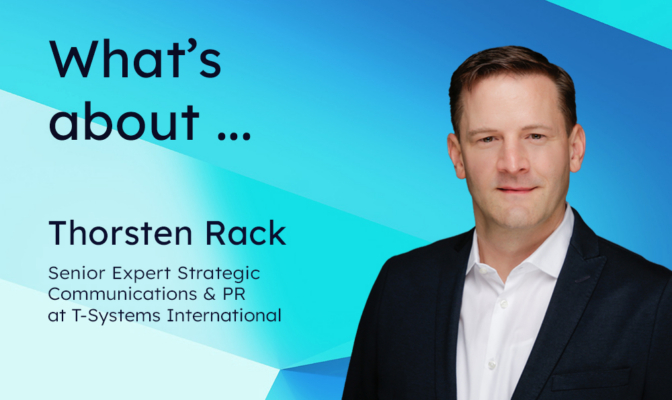
We have been an established player in the German strategic communications market for 30 years now. Over the course of our company’s history, a number of our colleagues have moved on to other companies, associations, institutions, start-ups or other consultancies. We have maintained collegial, friendly contact with many of them since. From now on, every six weeks we will ask one former colleague: What are you up to right now?
In our ‘What moves our alumni?’ series, it’s our former colleague Thorsten Rack‘s turn to answer our questions this time. Thorsten worked at H/Advisors Deekeling Arndt until 2006 and, following various other roles, has been Senior Expert in Strategic Communications & PR at T-Systems International since early 2024.
At T-Systems, you’re tackling major issues of our time, such as artificial intelligence and digital sovereignty. What makes your work so rewarding to you?
That’s right! At T-Systems, our work focuses on areas such as AI and cloud solutions, digital sovereignty and the protection of critical infrastructure. Given current global political trends, all these issues have a decisive impact on the independence, resilience and competitiveness of businesses and entire economies.
I find it incredibly exciting to be part of the comms teams that is helping shape all this from the front line. We work every day to convey the significance and added value of these topics to both in-house and general audiences through a wide range of communications formats. We are thus able to provide guidance and actively support change. At the same time, the increasing relevance of these issues is helping us to fundamentally change the way T-Systems is perceived. For a long time, people were sceptical about our company’s potential. That has changed completely over the past two and a half years. We are now seen as a key differentiator for Deutsche Telekom as a whole. I already experienced something similar when I worked with Telekom’s customer service. There too, we worked for years to successfully transform public perception of our company in a lasting way – from whipping boy to an outstanding service champion.
That is precisely what makes my work so rewarding: using communications not merely as a supporting function, but as an active catalyst for change – and thereby making a tangible difference.
What experience did you gain from strategic communications consulting that’s useful for an in-house role?
During my six years at H/Advisors Deekeling Arndt, I had the opportunity to contribute to a number of major change projects (Deutsche Bank, Deutsche Bahn, RWE, etc.). I learnt a great deal during that time that continues to be of great help to me in my work even twenty years later: structuring complex changes, developing clear narratives, and understanding communications as an integral part of transformation rather than an afterthought.
Understanding the dynamics of complex change processes was also a key lesson for me. Transformation is never just a matter of good messaging. It is always about interests, expectations, power dynamics and potential resistance. Recognising this complex interplay early on and anticipating it through communications is enormously valuable in a corporate environment such as the one I’m in.
Furthermore, from a corporate perspective, it is not enough simply to develop a good strategy. What is crucial is to consistently drive these issues over extended periods (often years), embed them within the company and stay on course even in the face of resistance. You have to form alliances, bring together different perspectives and structure communications in such a way that change actually takes effect in everyday life. For me, this is precisely what makes my in-house role so appealing today.
You started your career as a print journalist. Where do you see journalism in five years’ time?
I am convinced that journalism will be even more relevant in five years’ time – but that it will operate differently. The volume of information and disinformation continues to grow exponentially, not least due to AI. This makes context, reliability and curated relevance all the more important. This is precisely where journalism’s true strength lies, and it’s why this core function will continue to grow in importance.
At the same time, the business model will continue to change. The editor-in-chief of a long-established regional newspaper recently said to me: “We don’t have a reach problem, we have a monetisation problem.” This is an issue faced by many media outlets. In the long term, therefore, the most successful journalism will be that which builds trust, has a clear profile and cultivates a loyal community – regardless of the channels it uses.
What I’m also observing is that the boundaries between traditional journalism, corporate communications and individual voices – for instance on LinkedIn or in podcasts – are blurring. This means there is more competition for attention, but at the same time it makes quality and credibility even more important. This is exactly where journalism’s.
More about Thorsten Rack on LinkedIn.